Main Menu
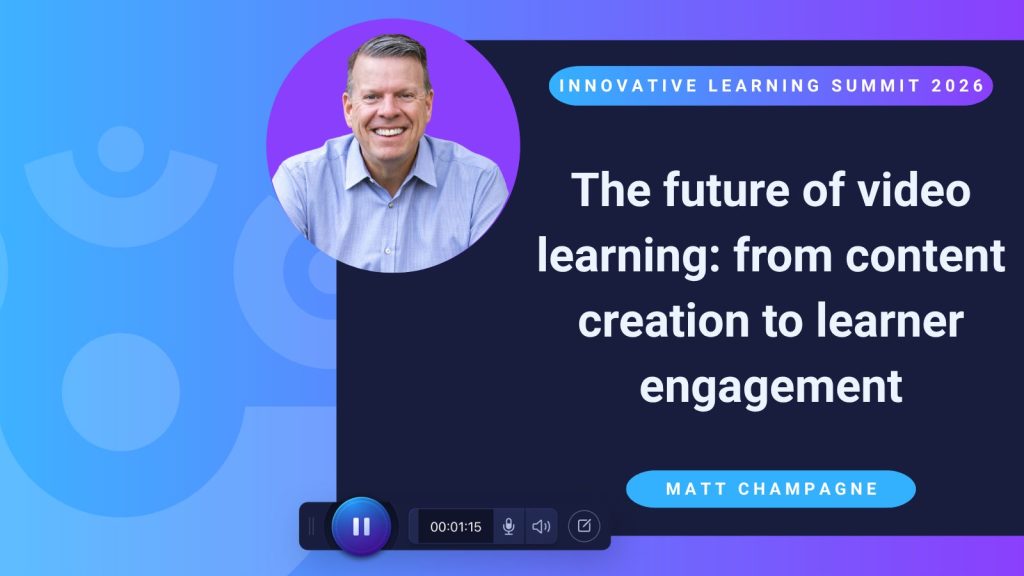
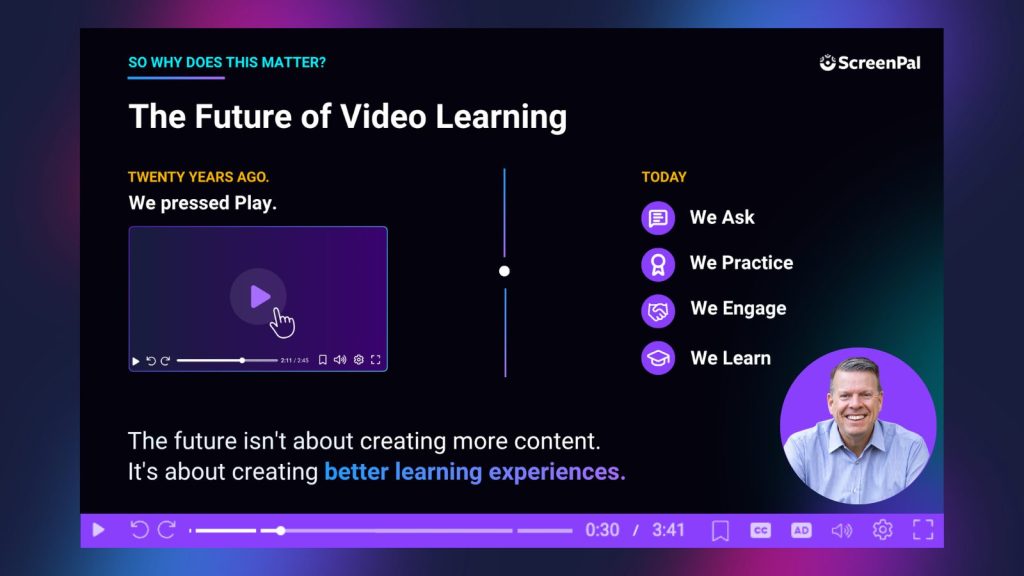
Twenty years ago, learning from a video was a largely passive experience: you pressed play, watched, and hopefully walked away knowing something you didn’t know before. Today, the AI video experience is changing dramatically.
Learners can increasingly search a video for the exact information they need, complete assessments while they watch, receive personalized guidance, and even use AI to interact with the knowledge contained within a video.
And we’re only at the beginning.
At the ScreenPal Innovative Learning Summit, ScreenPal CEO Matt Champagne opened the event by exploring how video learning has evolved over the past two decades, and where AI video may be headed next.
His central message was simple:
The future isn’t about making more videos. It’s about creating better learning experiences.
As AI, digital tools, and learner expectations continue to evolve, video has an opportunity to become more interactive, accessible, personalized, and effective. But the most important part of learning remains unchanged: human connection.
Here’s a closer look at what that means for the future of video learning.
Twenty years of learning from our community
ScreenPal began 20 years ago with a straightforward mission: make it easy and affordable for anyone to create and share video.
Our first product was a simple screen recorder. But it quickly became clear that recording was only the beginning.
Our customers needed to edit what they created. Then they needed somewhere to host and organize their videos. As video became a larger part of teaching, training, and communication, they wanted to make those videos interactive. And today, they’re exploring how AI videos can make both creating and learning more effective.
That evolution has been guided in large part by the people using ScreenPal.
One story from Matt’s keynote captures that relationship particularly well.
Years ago, when the ScreenPal team attended one of its first education events, two longtime customers approached the booth. They had written a song about ScreenPal and choreographed a dance to go with it.
What stood out wasn’t simply their enthusiasm for a piece of software. It was why they were enthusiastic.
The technology was easy enough to use that it got out of their way. Instead of spending their time learning complicated software, they could focus on teaching.
That idea has remained fundamental to how we think about learning technology.
Technology should remove barriers between people and what they’re trying to accomplish. And when it comes to education, it should strengthen the relationship between teachers and students, mentors and colleagues, coaches and teams, not get between them.
We’ve gotten good at creating videos. Now what?
Video is already one of the most powerful formats available for learning.
It can combine visuals, narration, demonstrations, text, and human presence in a way few other formats can. But simply putting information into a video doesn’t automatically create an effective learning experience.
As Matt noted in his keynote, we’ve become very good at creating video. The bigger opportunity now is learning how to use it to deliver great learning experiences.
Five challenges illustrate where that opportunity lies.
1. Turning passive viewing into active learning
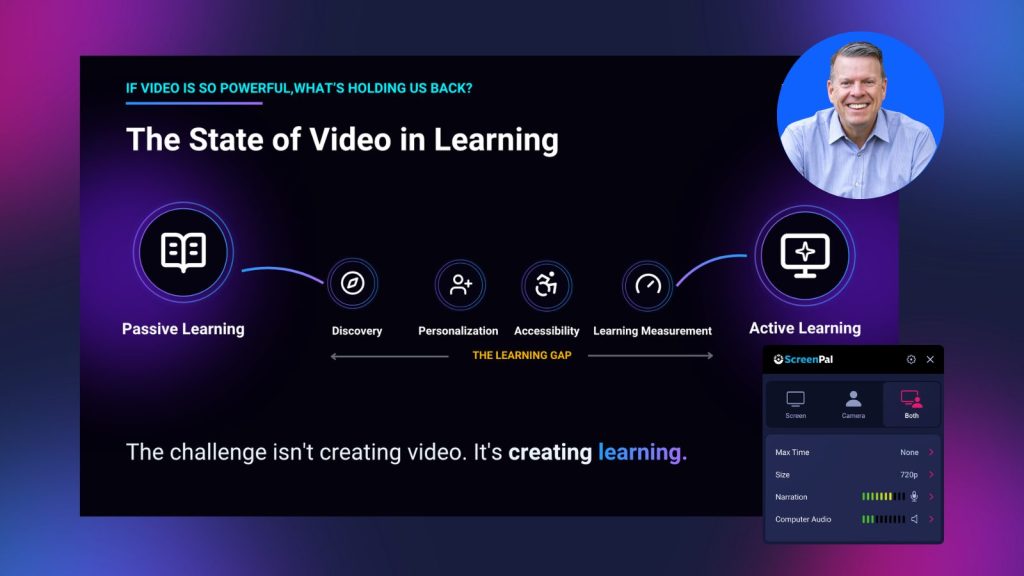
Watching isn’t necessarily learning.
A learner can sit through an entire video without reflecting on the material, practicing a skill, or testing whether they actually understand what they’ve seen.
That distinction is increasingly important as educators and families also think critically about screen time. The question shouldn’t simply be how much time learners spend with video, but what they’re doing during that time.
Quizzes, questions, discussion, reflection, and collaboration can transform video from something learners consume into an experience in which they actively participate.
The shift is subtle but important:
Instead of asking, “Did the learner watch the video?” we can ask, “What did the learner do with what they learned?”
2. Making knowledge easier to discover
Video can communicate an enormous amount of information; but finding one specific piece of information inside a video can still be frustrating.
Imagine remembering that an instructor explained an important concept somewhere in a 30-minute lesson. With a document, you can search for a word or phrase in seconds. With traditional video, you may find yourself jumping through the timeline trying to locate the right moment.
That makes discoverability an increasingly important part of video learning.
Chapters, searchable transcripts, summaries, audio descriptions, and AI-powered search can help learners move directly to the information they need instead of rewatching an entire lesson.
The result is video that works less like a recording stored on a shelf and more like an accessible knowledge resource learners can return to whenever they need it.
3. Creating more personalized learning experiences
Not every learner needs the same explanation.
Someone encountering a topic for the first time may need additional context and examples. Someone with more experience may want to skip the basics and focus on a specific concept.
Traditional video usually presents the same linear experience to everyone.
The next generation of video learning has the potential to be much more flexible.
Learners may be able to explore concepts at their own pace, ask for additional explanations when they’re confused, skip material they’ve already mastered, and follow learning paths that respond to their individual needs.
In other words, the video itself can become only the starting point for the learning experience.
4. Making accessibility part of the workflow
For video to fulfill its potential as a learning tool, every learner needs an equitable opportunity to engage with it.
Accurate captions, transcripts, audio descriptions, and language support can remove barriers and make learning content useful to a much wider audience.
Yet adoption still has room to grow.
In a ScreenPal survey cited during the keynote, only 16% of K-12 educators and 39% of higher education educators surveyed said they caption most of their videos, while audio descriptions were even less common.
Technology has made these accessibility features dramatically easier to create. The next challenge is making them fast, affordable, and scalable enough that accessibility becomes a natural part of publishing a video rather than another task added to an educator’s workload.
5. Understanding whether learning actually happened
One of the hardest questions in video learning is also one of the most basic: Did it work?
A view tells us that someone opened a video. A completion percentage might tell us how much they watched. Neither necessarily tells us what they understood.
Educators and trainers ultimately want to know what learners understood, what they retained, and whether the experience changed what they could do afterward. That’s why assessments and learning analytics are becoming increasingly important companions to video. And that shift brings us to the larger story of how video learning has evolved.
From “watch” to “converse”: how video learning evolved
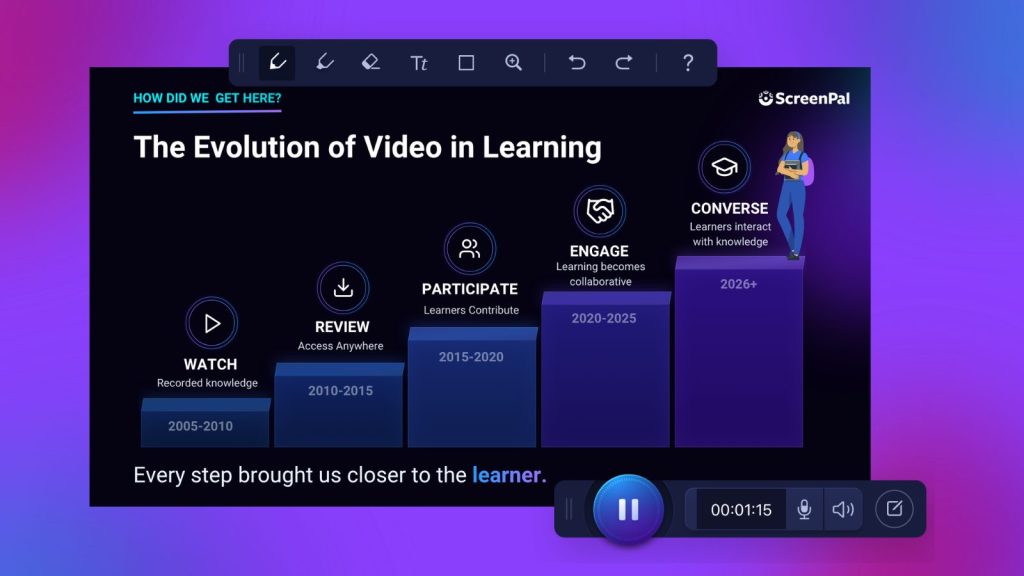
Looking back over the past 20 years, we can see several distinct stages in the evolution of video learning. Each stage moved learners further away from simply consuming information and closer to actively engaging with it.
Watch: 2005-2010
The first era was about recording knowledge.
Screen and webcam recordings, narrated presentations, and lecture capture gave educators and trainers new ways to make their knowledge available beyond a live classroom or training session.
But many of the tools were expensive, complicated, or dependent on IT support. That created an important imperative for the next generation of video technology: creation needed to become easier, more affordable, and more scalable.
Review: 2010-2015
The next era made knowledge available anytime.
The flipped classroom demonstrated what could happen when educators moved video outside the classroom and reserved synchronous time for discussion, collaboration, and problem-solving.
Microlearning also gained momentum. Instead of long presentations, organizations increasingly created short, focused videos around a single concept or task.
At the same time, searchable video libraries became valuable repositories for onboarding, support, compliance, and institutional knowledge.
Video wasn’t simply capturing something that happened at a particular moment anymore. It was becoming reusable knowledge.
Participate: 2015-2019
Then learners became participants and contributors.
Interactive video introduced quizzes, embedded questions, clickable elements, and completion tracking. Student-created videos gave learners another way to demonstrate understanding.
Video also became a powerful medium for feedback and mentorship.
Instead of writing comments on an assignment, an instructor could record personalized feedback. Instead of communicating solely through text, mentors and learners could have asynchronous video conversations that preserved something written communication often loses: human presence.
Research presented in the keynote from Dr. Martin Mehl at Cal Poly, for example, explored how asynchronous video conversations could create more meaningful mentor relationships compared with traditional written feedback.
Engage: 2020-2025
Remote and hybrid learning dramatically accelerated video adoption.
Almost overnight, educators and workplace trainers who had rarely created video found themselves recording lessons, meetings, onboarding materials, demonstrations, feedback, and training.
Video messaging grew as well, creating new opportunities to communicate and collaborate asynchronously.
Then generative AI began changing the production process.
AI videos are now created from prompts or slide decks and AI generates captions, summaries, chapters, translations, quizzes, audio descriptions, and editing suggestions. The goal wasn’t necessarily to remove the creator from the process. It was to reduce the repetitive work surrounding creation so people could spend more time on the parts that required their expertise.
Converse: 2026 and beyond
Now we’re entering a fundamentally different stage.
Instead of simply watching knowledge, learners can begin to interact with it.
A video doesn’t have to be a one-way transmission anymore.
A learner can potentially ask a question.
Search for a concept.
Request another explanation.
Test their understanding.
Explore related information.
Receive guidance based on what they do and don’t understand.
Over the past two decades, video learning has moved from recording knowledge to delivering it, engaging learners with it, and now potentially partnering with learners as they develop understanding.
That may be one of the most important shifts yet.
The next era: AI-powered learning experiences
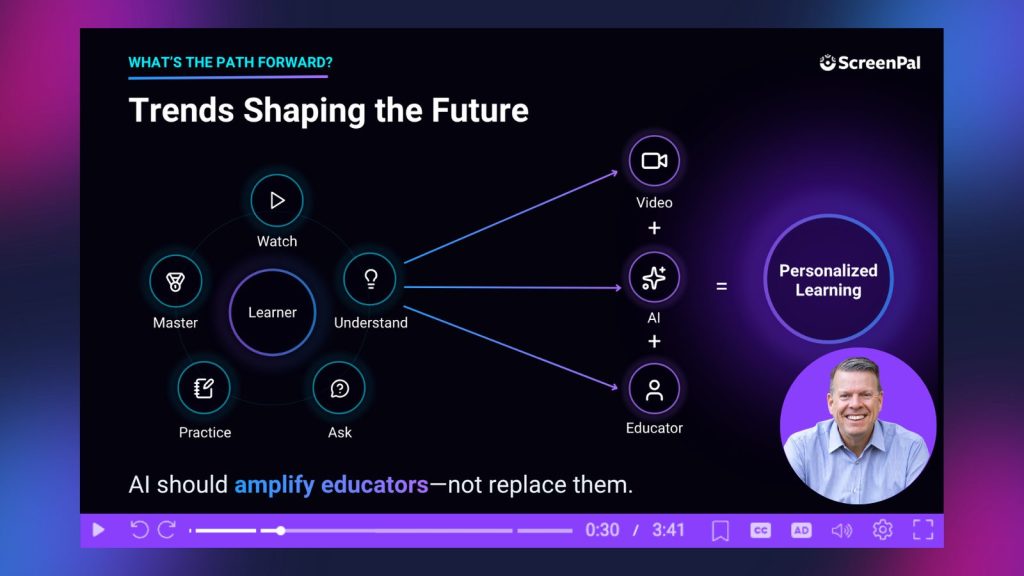
Much of the conversation around AI and video has focused on creation.
How quickly can AI generate a video?
Can it write the script?
Can it generate narration?
Can it edit footage?
Those are useful questions. But they may not represent AI’s most significant impact on learning.
The bigger opportunity is what happens after someone presses play.
Imagine a nursing student watching a lesson about diagnosis.
She reaches a concept she doesn’t understand and asks the video to explain it differently. Instead of replaying the same section, she receives another explanation along with links to relevant moments in the original lesson.
Then she asks to be quizzed.
The learning experience identifies an area where she’s struggling and gives her additional guidance.
By the time she arrives in class the following day, she’s not just watched the assigned content. She interacted with it, tested herself, identified gaps in her understanding, and arrived better prepared for a deeper conversation with her professor and classmates.
And AI video can potentially help the instructor, too.
The professor could see which questions students asked most frequently, identify parts of the video they replayed, and discover concepts that caused confusion.
Those insights could inform the next class, the next assignment, or a conversation during office hours.
That’s a very different relationship between video, learner, and educator.
Instead of technology distancing educators from their learners, it can help educators better understand where learners need them most.
AI video doesn’t make human connection less important
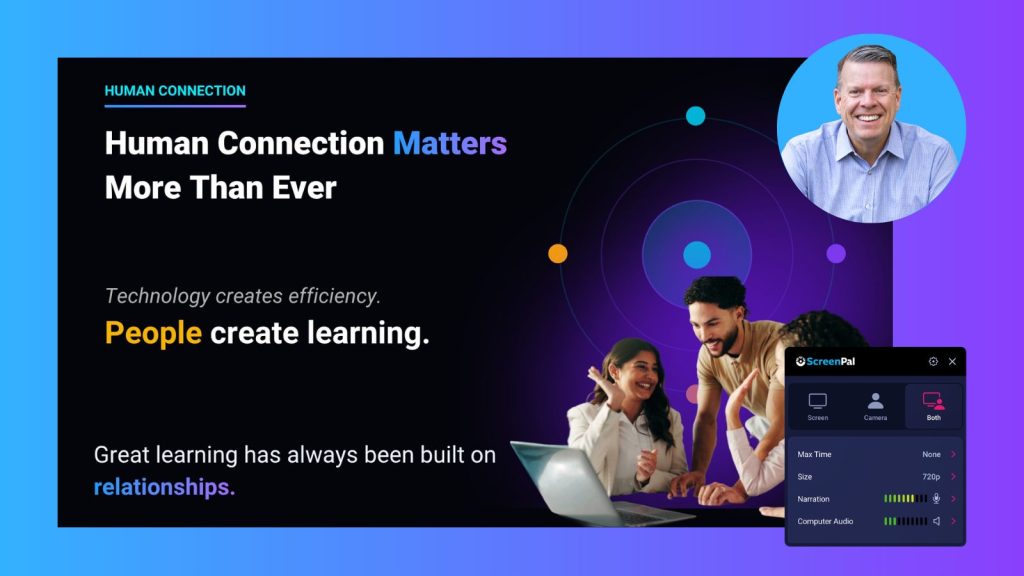
It’s tempting to assume that more AI video means less human involvement.
For learning, we believe the opposite can be true.
AI can help accelerate content creation. It can make knowledge easier to find. It can help personalize practice, remove accessibility barriers, and surface insights from learning activity.
But it cannot replace the relationships at the center of meaningful learning:
A student still benefits from knowing that a teacher sees their progress.
An employee still benefits from a mentor who understands their goals.
A learner still benefits from encouragement, context, judgment, empathy, and expertise.
Video has always been uniquely valuable because it can preserve some of that human presence even when people aren’t in the same place, or learning at the same time.
That’s why one of the most important trends shaping the next generation of video isn’t technological at all.
It’s presence and authenticity.
As Matt shared during the keynote, video creates connections that text alone often cannot. Used thoughtfully, it can help us maintain a human-centered approach even as AI becomes a larger part of how learning experiences are created and delivered.
What should educators and trainers do next?
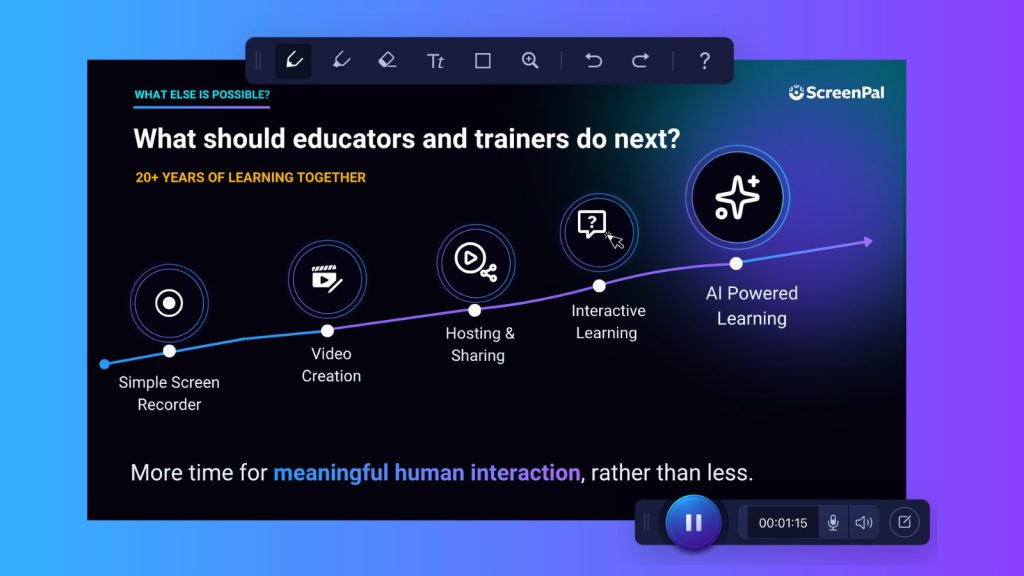
The future described here doesn’t require abandoning the approaches that already work.
It means asking what else might be possible.
If you already use video in your teaching or training, consider looking beyond simply recording a lecture, presentation, or demonstration.
Could learners interact with the content instead of only watching it?
Could a quiz or reflection prompt turn viewing into active practice?
Could searchable transcripts and chapters make important knowledge easier to rediscover?
Could captions, audio descriptions, or language support make the experience more accessible?
Could analytics show you where learners are struggling?
Could AI help a learner ask the question they might otherwise have to wait until tomorrow, or next week’s class, to ask?
And could all of those things ultimately give you more time for meaningful human interaction, rather than less?
These are the questions worth exploring as video learning enters its next era.
The future of video learning is still human
Technology will continue to evolve.
Video will become smarter. AI will become more capable. Learning experiences will become increasingly interactive and personalized.
But the goal isn’t to create more technology.
And it isn’t to create more videos.
The goal is to help people learn.
Great learning has always been built on relationships: between teachers and students, mentors and colleagues, coaches and teams. Over 20 years of working alongside educators, trainers, and organizations, that lesson has remained remarkably consistent.
The opportunity now is to build technology that strengthens those relationships.
Because no matter how sophisticated the tools become, learning remains a fundamentally human experience.
And that’s the future of video learning worth building.