Main Menu
What if the real value of video mentorship isn’t simply what you record, but what you preserve?
During the ScreenPal Innovative Learning Summit, educator, researcher, entrepreneur, and mentorship advocate Martin Mehl, Professor of Communication Studies at California Polytechnic State University, San Luis Obispo, and Founding Director of the Cal Poly AI Immersion Lab | AI2 (AI Literacy & AI Agile Build) an Industry Partnerships, sponsored by the Office of the President & Office of the Provost), invited attendees to look at video through a much wider lens. His session, One lens, three focal lengths: Scaling mentorship through captured communication, moved from the classroom to higher education to the workplace, exploring how captured communication can help us support an individual learner in the moment, build mentorship programs that scale, and preserve knowledge long after a conversation has ended.
Martin began with an important distinction: Good mentorship isn’t about having all the answers. It’s about creating a place where someone feels safe enough to learn.
Mentorship starts with being seen
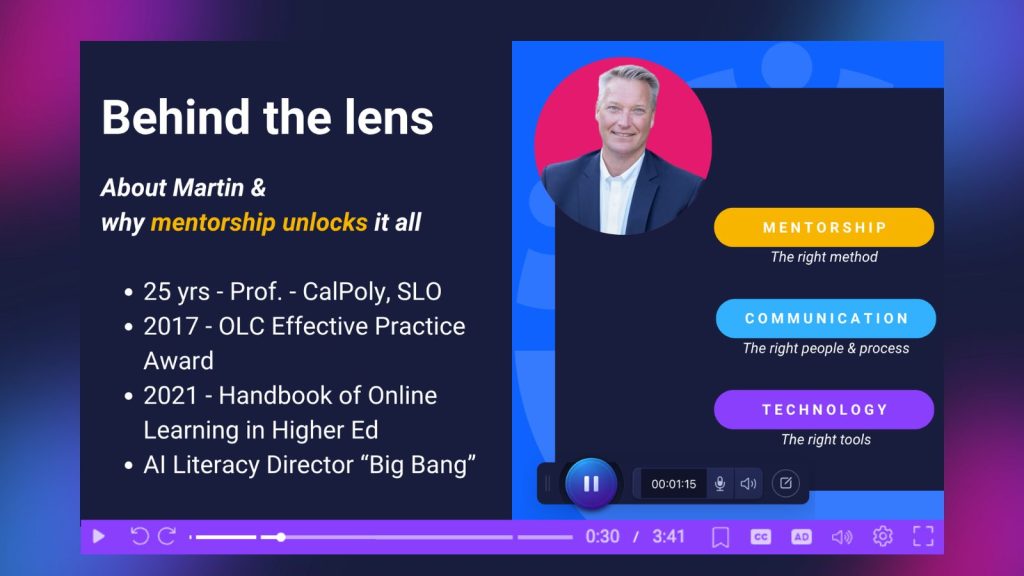
Before introducing frameworks, technology, or research, Martin set the foundation for the entire session. “Mentorship is not a skill that arrives automatically,” he explained. It isn’t something someone earns simply because of their title or experience. Instead, he described mentorship as an art form built around safety and support.
There’s also an important difference between being watched and being seen. For Martin, mentorship creates space for the moments when someone takes a risk, asks a question, admits uncertainty, or tries something new. Those moments can be fleeting. He therefore encouraged attendees to recognize both the wins and the setbacks instead of immediately rushing toward whatever comes next.
He connected the idea to the German word Augenblick: literally, the blink of an eye, or a moment worth keeping. That became Martin’s bridge to video. A recording can become a kind of freeze frame: a captured moment a learner can return to and a mentor can continue building upon. In that sense, recording isn’t only about creating content. It can make care, guidance, and human connection visible and replayable.
First mentorship focal length: The individual educator
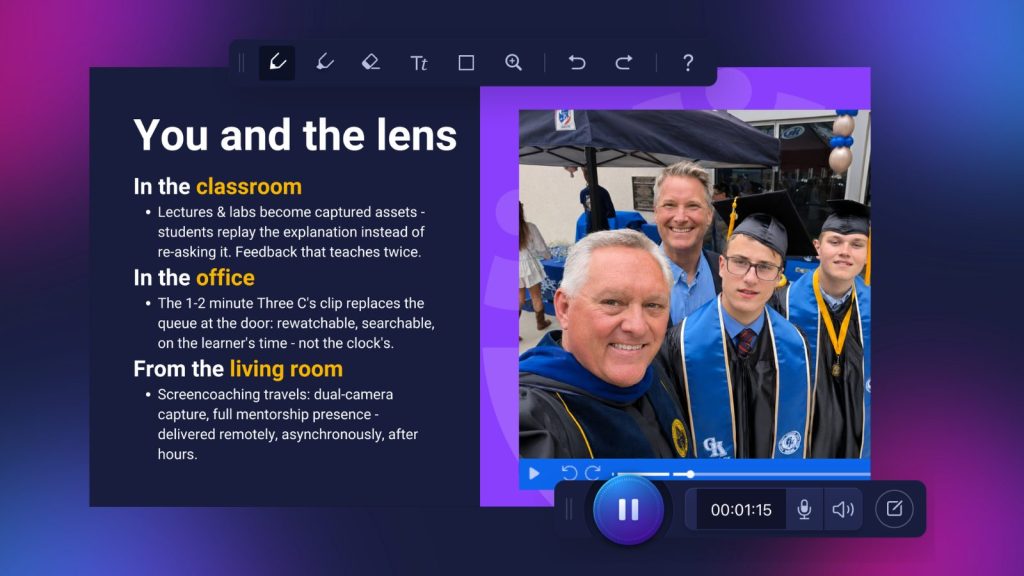
Martin then put on his first metaphorical set of glasses. The closest focal length was the individual educator working directly with a learner. Drawing on more than two decades at Cal Poly, Martin traced his own experimentation with educational technology back to podcasting in 2006.
One student taught him an early lesson. The student appreciated Martin’s creativity but pointed out that hearing his professor suddenly appear in his headphones while running on the beach wasn’t exactly welcome. It was funny, but the lesson stuck. Technology had allowed Martin to leave the physical boundaries of the classroom. That meant educators had to think differently about where, when, and how they entered students’ lives.
A decade later, Martin and instructional designer Dr. Luanne Fose began exploring another question: Could recorded communication make feedback more meaningful?
Consider what happens when an instructor returns a paper covered in comments. A high-performing student may glance at the grade and move on. Another student may feel discouraged by the markings. Some may never seriously engage with the feedback at all. Martin and his colleagues wondered what would happen if, instead of reaching for the red pen, an educator reached for the record button.
A video could let an instructor walk through the learner’s work while explaining what they noticed, what was successful, where the learner could improve, and why. Suddenly, feedback had a voice. It had context. It had a person behind it.
Martin recalled introducing the approach to an experienced master educator who had been skeptical of technology. Within minutes of seeing ScreenPal, her reaction was essentially: Where has this been my entire life? That experience helped fuel a series of research articles on what Martin and his colleagues called the Digital Academic Revolution, eventually contributing to their work on mentorship and digital literacy in The Handbook of Online Learning in Higher Education.
Martin’s point wasn’t simply that educators should record more videos. It was that recorded communication gives educators another way to be present for learners.
The mentor has to remain a learner, too
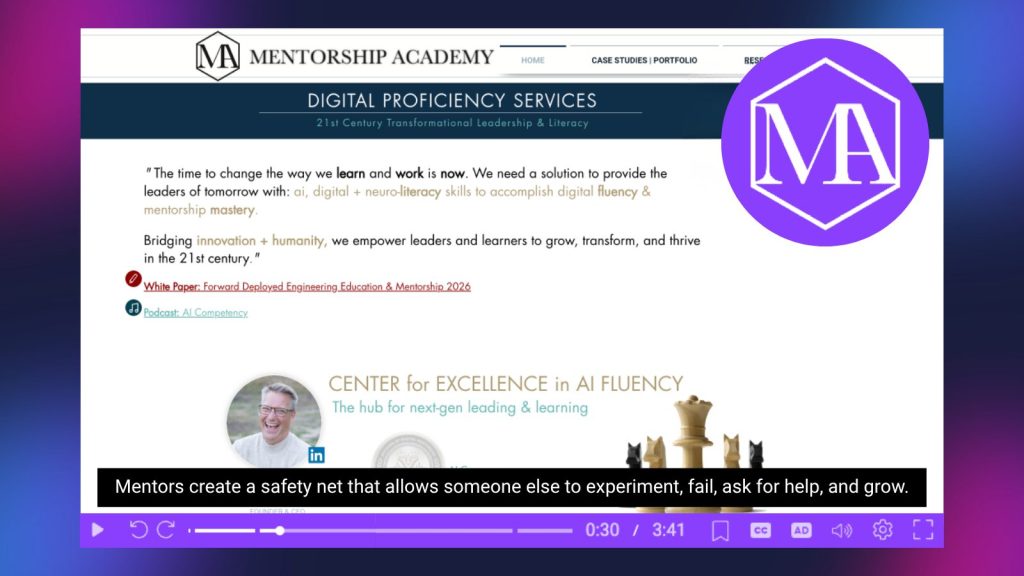
From there, Martin returned to the responsibility that comes with mentorship. A mentor should never confuse someone’s respect for them with proof that they are always right. “You don’t get to be better than your audience,” Martin told attendees. Instead, mentors create a safety net that allows someone else to experiment, fail, ask for help, and grow. That applies whether you’re teaching a K-12 student, working with a college learner, supporting a colleague, or mentoring someone entering a new profession.
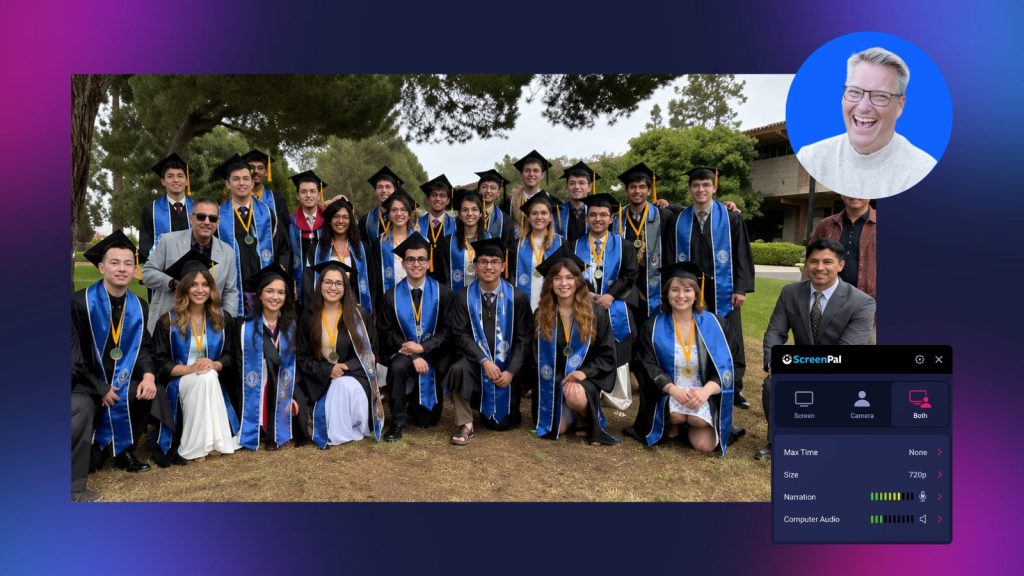
Martin also brought the idea home, literally. As the father of twin sons who had just completed high school, he shared a photo from one of their graduation milestones and reflected on all of the people who had contributed to getting them there: parents, educators, classmates, mentors, and mentees. No meaningful learning journey, he reminded the audience, happens alone. That brought the session to its second focal length.
Second mentorship focal length: From individual mentorship to a system
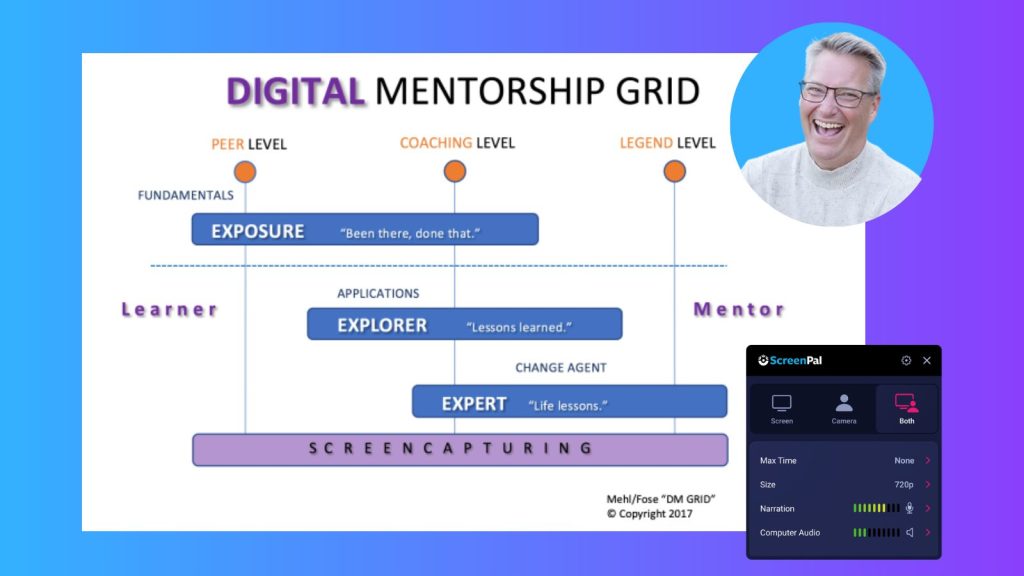
Put on another set of glasses and the frame gets wider. Instead of asking, “How can I help this learner?” Martin asked attendees to consider another question: How do we build mentorship that continues helping people beyond one conversation, one course, or one mentor? This is where captured communication begins to become infrastructure.
Martin encouraged attendees to think in terms of repositories, mentorship pods, and reusable knowledge. If an experienced colleague explains a process brilliantly, why should that explanation disappear after one meeting? If a mentor helps one person work through a common challenge, could that insight help the next person, too? If someone leaves an organization, does their knowledge have to leave with them? Recorded communication makes it possible to begin preserving those moments.
Martin cautioned against building something that rises and falls with one enthusiastic person. From the beginning, he encouraged attendees to think about growth and scalability. “Never think this is just for me,” he said. Instead, consider how what you create could become a model another instructor, department, team, or organization can build upon. A single video may solve an immediate problem. A thoughtfully designed collection of captured expertise can become an institutional resource.
Building mentorship “pods”
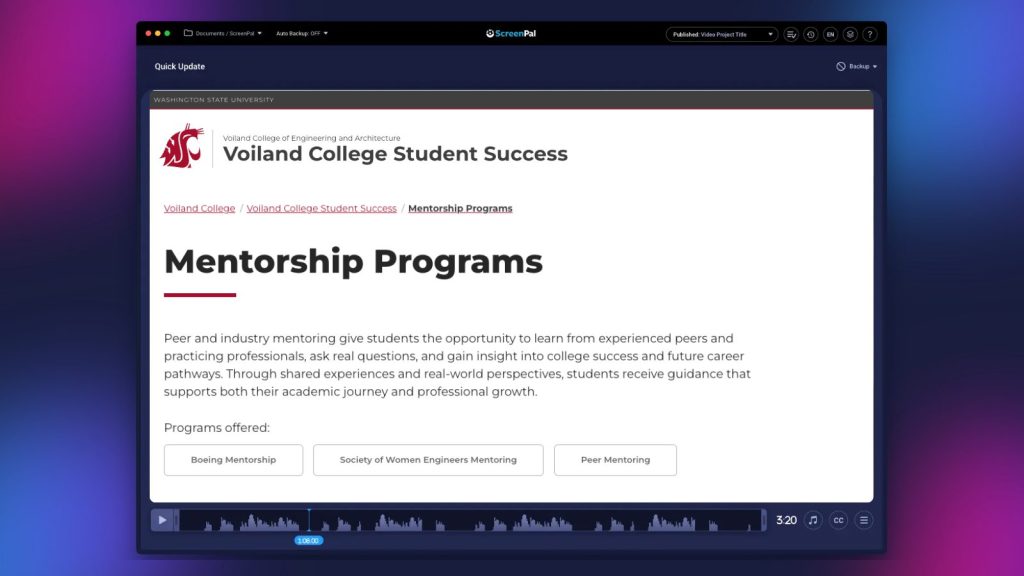
Martin then introduced the idea of mentorship pods: bringing together people with different expertise so learners aren’t dependent on one mentor to provide everything. He illustrated the concept through work underway at Washington State University, where he has been collaborating with engineering faculty on a model connecting higher education, mentorship, technology, and industry.
The goal is not simply to give students information. It is to surround them with expertise. A learner might benefit from the perspective of a strategist, a communications expert, and an engineer. Screen recordings, demonstrations, walkthroughs, and living portfolios can help capture those perspectives and make them accessible asynchronously.
Martin described the larger vision as a combination of: Technology + mentorship + ambition + success. The project is still something Martin approaches as a researcher, meaning the results have to be tested rather than assumed; but he sees significant potential for this kind of captured mentorship to help students transition from education into the workplace with more confidence and practical experience. Once the lens moved into the workplace, the frame widened again.
Third mentorship focal length: The executive view
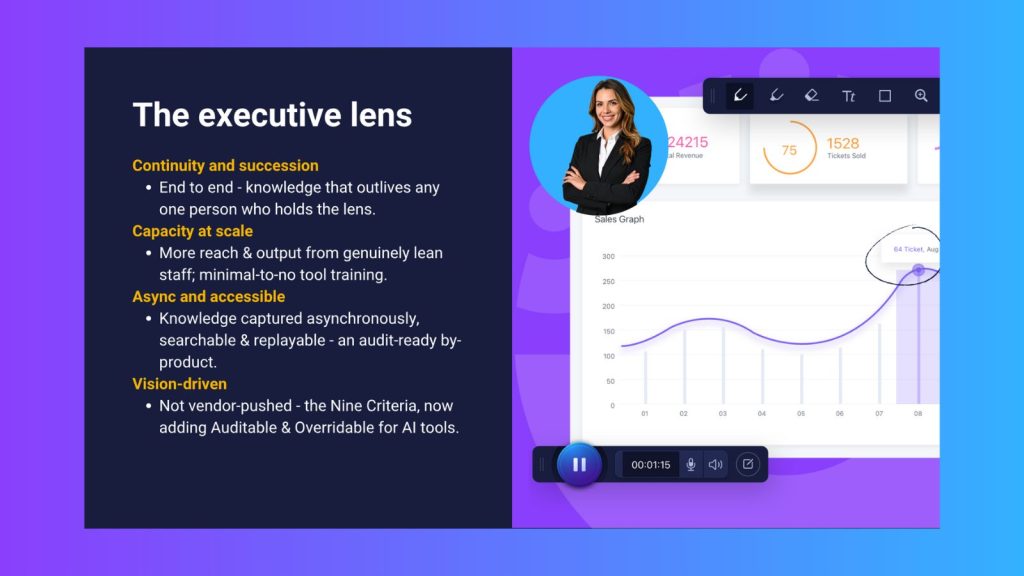
For Martin’s third focal length, attendees were asked to look at the entire organization as a single frame. At this level, mentorship isn’t simply a learning activity. It connects to onboarding, succession planning, productivity, employee retention, institutional knowledge, and ultimately business performance.
Think about the knowledge held by your most experienced employees. What happens when they retire? What happens when a great manager leaves? What happens when an employee has answered the same onboarding question dozens of times?
Traditionally, organizations have relied heavily on synchronous transfer: meetings, calls, job shadowing, and one-to-one conversations. Those interactions are valuable, but they’re also difficult to scale. Captured communication changes the equation. An expert can record a process once. A mentor can preserve an explanation. A leader can document not just what a decision was, but the thinking behind it.
That knowledge can then be revisited, shared, clipped into smaller resources, embedded into documentation, and passed along to people the original speaker may never even meet. For Martin, that’s where recording becomes more than documentation. It becomes a legacy.
What does AI change?
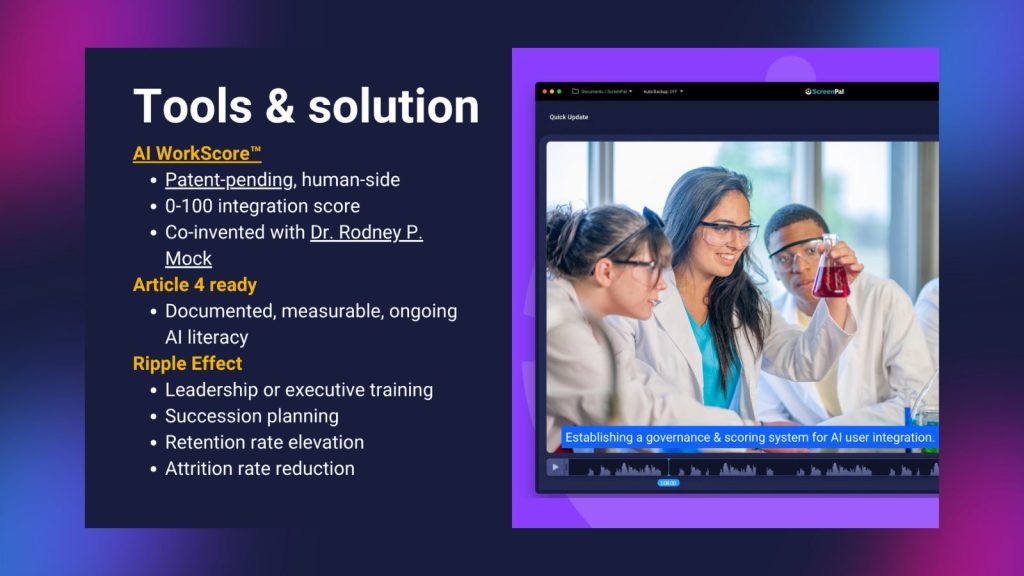
As Martin widened the lens to the organizational level, artificial intelligence naturally entered the conversation. He resisted treating AI as a replacement for human expertise, however. Instead, he described AI as another reason organizations need stronger mentorship, digital literacy, and critical-thinking systems.
As AI becomes embedded into education and the workplace, people need to learn not simply how to use the technology, but how to evaluate it. How do we know whether AI produced a good result? What is the baseline? How do we measure quality? Who remains responsible for judgment? Those questions matter because adoption without evaluation produces confidence without competence. An organization that cannot articulate its baseline for quality has no way of knowing whether AI is improving its work or quietly eroding it. Martin argued for keeping the human firmly in the loop and building measurable AI literacy alongside technological adoption.
While he didn’t discuss it during his Summit session, Martin’s work also extends into this area through AI WorkScore, a patent-pending AI integration scoring system designed to measure how AI is incorporated into work.
That makes mentorship even more important. The technology may change quickly. Human beings still need guidance to learn how to use it responsibly, critically, and effectively.
Capture the thinking, not just the meeting
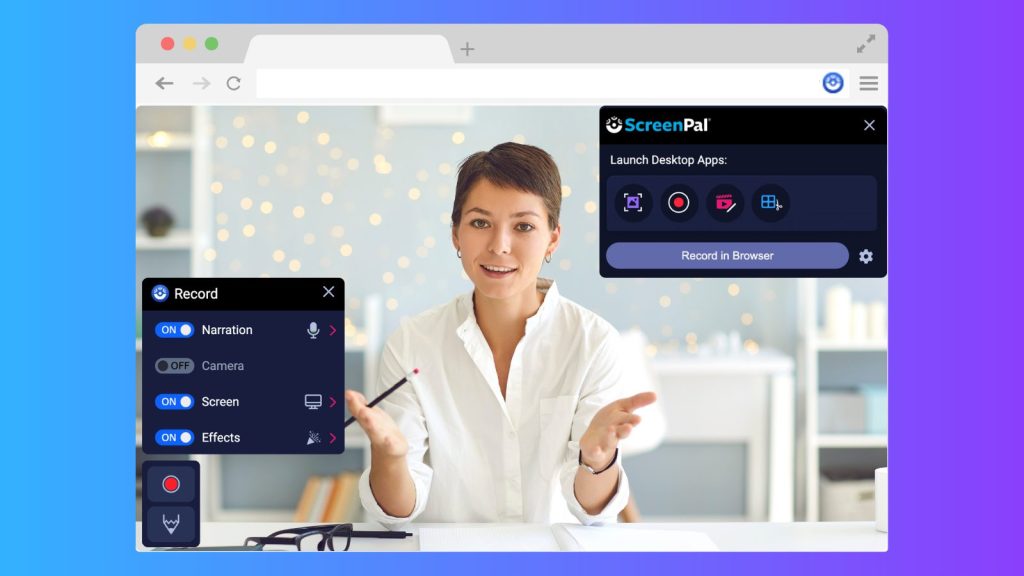
The conversation continued into Q&A, where Martin offered an especially practical example for researchers and collaborative teams. A shared Google Doc might contain comments and annotations, but written comments can easily lose tone and context. Instead, Martin suggested recording a quick video explaining what you were thinking and embedding it alongside the work. You don’t need another meeting. You don’t need to schedule a video conference. You simply capture the explanation while the thinking is fresh.
That also preserves something text often strips away: nonverbal communication. A smile, a smirk, an encouraging tone, or the expression on someone’s face can completely change how a message is understood. For Martin, turning on the camera isn’t about looking polished. It’s about giving the other person more of the information they need to understand you.
Asynchronous video creates another benefit: People can contribute when they’re ready. Someone who didn’t feel comfortable speaking during the meeting can record a thought later without the same group or peer pressure. A colleague in another time zone can add context without forcing everyone onto another call. The result is communication that can remain collaborative without always needing to be synchronous.
How can you become a better mentor, or mentee?
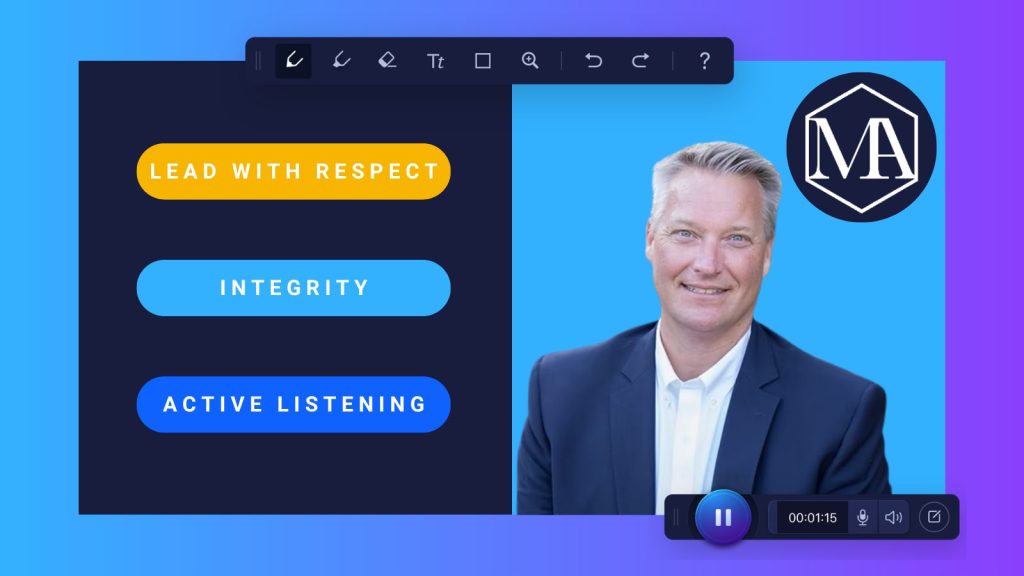
One attendee closed the session with a big question: What advice would Martin give someone who wants to become a better mentor or mentee? His first answer was immediate: Lead with respect. Whether someone made a mistake, misunderstood something, or approached a problem differently, judgment doesn’t need to enter the room. “If respect isn’t the foundation of the conversation, there is no mentorship,” Martin said.
Next comes integrity. Mentorship isn’t an opportunity to show off what you know. If someone has approached you for guidance, they have already demonstrated respect for your experience. Then comes active listening. The conversation isn’t about the mentor. It’s about understanding the person seeking guidance, what they need, and which skills or resources can help them move forward.
For mentees, Martin returned once more to captured communication. Taking detailed notes while also trying to listen, process, ask questions, and be fully present can be difficult. When appropriate, recording the conversation creates a resource the mentee can revisit later. Unlike a long meeting recording that may disappear into an archive, captured communication can be transformed: clip an important section, revisit a specific explanation, embed it into another resource, or share a mentor’s insight with someone else who needs it.
One mentorship recording can have a much longer life
By the end of the session, Martin had taken attendees from a single interaction between educator and learner all the way to the organization-wide implications of preserving human knowledge. The technology itself remained the same. The focal length changed.
Up close, captured communication can help one learner feel seen and supported. Pull back, and it can help mentors share knowledge across programs, teams, and communities. Pull back again, and it can help an organization preserve expertise, improve onboarding, support succession, and build a culture in which knowledge continues moving from one person to another.
That’s the opportunity Martin sees in tools like ScreenPal. Don’t simply record what happened. Capture the moments worth returning to. The explanation you preserve today might eventually help someone you haven’t even met yet.
Watch Martin Mehl’s full Summit session
Want to experience the complete session and hear Martin’s stories, research, examples, and mentorship philosophy in his own words? Watch “One lens, three focal lengths: Scaling mentorship through captured communication” on demand as part of the ScreenPal Innovative Learning Summit. As you watch, consider Martin’s challenge: What knowledge, guidance, or experience exists in your classroom, team, or organization today that is worth capturing for tomorrow?
About the speaker
Martin Mehl is Professor of Communication Studies at California Polytechnic State University, San Luis Obispo, and serves as Founding Director | Cal Poly AI Immersion Lab | AI Literacy & AI Agile Build | Industry Partnerships, Office of the President & Office of the Provost. The Lab’s slogan: “Sharper Decisions, Stronger Business.”